Showing posts with label 2007. Show all posts

Tuesday, February 22, 2011

Peugeot Flux Concept, 2007

Peugeot Flux Concept, 2007


The concept car Flux, designed by Mihai Panaitescu, won the 4th Peugeot design competition. The car was designed to achieve universal pleasure by adapting different lifestyle situations. The theme of this fourth competition, summed up by acronym P.L.E.A.S.E. Innovate!, has inspired creativity of web based designers throughout world, resulting in more than 4,000 projects.

Complimenting present automotive aspirations, Flux has shown the theme’s most relevant illustrations, since its concept corresponds to a type of car that achieves utter driving Pleasure through its Light weight and Efficiency, while at the same time remaining Accessible through the Simplicity and Ecology of its design.

The Flux was chosen by a jury chaired by Frédéric Saint-Geours, General Manager of Automobiles Peugeot and made up of Peugeot representatives, its Style Centre, Xbox, but also of web based people who voted online.

Unveiled at this year’s Geneva show, and thanks to its sophisticated design, Flux will be making a second appearance at the Frankfurt Motor Show. Flux will appear ‘real’ in the form of a full-scale model presented at Peugeot’s exhibition space and ‘virtual’ in a new version of the PGR 4 game on Xbox 360. These two elements constitute the two most fantastic prizes of the 4th Peugeot design competition.

The 4th design competition attracted greater participation, with more than 200 additional projects compared with the 3rd competition (4,029 compared with 3,800), confirming its international appeal, with 113 countries represented as opposed to 107 in the last competition.

Friday, September 17, 2010

SSC ULTIMATE AERO TT, 2007

SSC ULTIMATE AERO TT, 2007


SSC ULTIMATE AERO TT, 2007

Want to drive fast? really seriously fast? you’re spoilt for choice at present – at least in terms of the machinery available, if not the roads to do it on... There’s the 253mph Bugatti Veyron, the 250+mph Koenigsegg CCXR and the Bristol Fighter T with a claimed top speed potential of 270mph, but which will be restricted to 225mph.
There’s also the Hennessey Venom Viper with a claimed top speed of 255mph.

The world’s most powerful production car, ever.
Boasting a truly gargantuan 1,183bhp, the small, little-known Washington State-based company claims a top speed capability of 273mph. In tests earlier this year on a closed section of Nevada highway the SSC managed 230mph in the two miles available, but had the originally intended 12 mile site not been hit by snow, then the Veyron could well have been humbled.

There’s little that’s impressive inside as fit, finish and detailing falls far short of the current supercar norm.
On the plus side the Aero TT is easy enough to climb in and out of, the leather seats are supportive, it’s reasonably spacious with ample headroom and the driving position is fine apart from the front wheel arch intruding into the footwell,

Despite the Aero TT’s massive torque, moving away sedately from a standstill requires a delicate balance of clutch and throttle.
It’s eager either to launch like a dragster, or stall. Despite SSC’s brochure claiming the TT’s rack and pinion steering is assisted.
Manoeuvring at parking speeds required strong arms and a firm, two-handed grip on the wheel, but once rolling the SSC is easy enough to drive with a precise gearchange and direct, accurate steering, even by mid-engined supercar standards.

Specification:
* Engine - mid-mounted, all-alloy 16-valve V8 twin turbo
* Displacement - 6,348 cc (387.2 cu in)
* Power - 1,183 bhp (1,199 PS) @ 6,950 rpm (7,200 rpm redline)
* Torque - 1,094 lb/ft (1,484 Nm) @ 6,150 rpm
* Transmission - 6-speed manual, rear wheel drive
* 0-60 mph - 2.78 secs
* Standing 1/4 mile - 9.9 secs @ 144mph
* 60-0mph - 31.4 metres (103 ft)
* Top speed - 273 mph
* Chassis - steel tube space frame
* Body - carbon fibre composite, flat undertray with venturi tunnels
* Cd - 0.357
* Brakes - 14 inch vented, cross-drilled discs, 8-piston* calipers (front), 6-piston* (rear), (*see text)
* Suspension - double wishbone (front); upper rocker arm, lower wishbone (rear), remote reservoir, adjustable Penske dampers, coil-over springs, anti-roll bar
* Wheels - forged, 3-piece alloy, 19 x 9.5” (front), 20 x 13” (rear)
* Tyres - Michelin Pilot Sport PS2, 235/35 19 (front), 335/30 20 (rear)

Thursday, September 16, 2010

Ascari A10, 2007

Ascari A10, 2007


Ascari A10, 2007

The British Supercar manufacturer, Ascari has produced the answer to the Ferrari Enzo FXX.

Whereas the Enzo FXX is not road legal, it was produced to be driven during track days only, the A10 is road legal so can be driven home and parked on your drive.

Designed, engineered and hand built in Banbury, England the A10 has 625bhp and weighs in at around 1200kg, thanks to its lightweight carbon fibre bodywork. Reaching 60mph in just 2.8 seconds and 100mph in less than 6 seconds, the manufacturer claims the A10 is the fastest road going production car around a race track.

The A10 is more than just a revamped KZ1, which has found success in its first year of competing in the GT3 in 2006. It has new body panels, a reworked engine and suspension, with extensive brake modifications to cope with the extra power. Some luxuries such as remote central locking, electric windows and door mirrors, climate control and a Thatcham Category 1 alarm system.

Friday, September 10, 2010

Peugeot 908 V12 HDi DPFS, 2007

Peugeot 908 V12 HDi DPFS, 2007


Peugeot announced its decision to accept a new technological challenge: to win one of the world's most prestigious and demanding motor races, the Le Mans 24 Hours, with a car powered by an HDi diesel engine equipped with a diesel particulate filter system (DPFS).

The monocoque body
The monocoque body is made of carbon and presents a truly closed structure, contrary to the 905, which was a "racing car" with a detachable tubular rollover bar. This type of structure offers strong natural rigidity (the "eggshell" effect) and allows the weight of the monocoque body to be optimised.

Body and aerodynamics
Created from scratch at the beginning of 2006, Peugeot Sport's aerodynamics department had the difficult task of designing in just a few weeks an exterior body that was both original and aerodynamically efficient.
3 months after the appointment of the aerodynamics project team leader, a model of the car was undergoing the first tests in the wind tunnel!
The car's profile results not only from the necessary compromise between aerodynamic efficiency and drag, but also the need to provide optimum airflow to the different radiators and intercoolers located within the generously dimensioned bodywork.

Suspension, steering, brakes
Given the challenge of designing a complete car in record time and the particular constraints of the HDi DPFS engine, the Peugeot Sport team relied on proven solutions for the front and rear suspension design, the electric power steering and the brakes.

The gearbox
This is positioned longitudinally and will allow the fitment of up to 6 gear ratios, the limit laid down by the regulations.
It has been designed to withstand the enormous torque of the engine, while ensuring optimum weight and size characteristics.
The gearbox is controlled electro-pneumatically.

The engine
The chosen engine architecture is a 100° V12 with a capacity of 5.5 litres. This is the maximum capacity permitted by the regulations and was chosen due to its greater internal airflow at low engine speeds. It also gives potential future development opportunities to use different grade fuels.
The choice of a twelve cylinder engine helps keep the cylinder bore diameter very close to that of a production series engine. In doing so, Peugeot can call on its extensive knowledge of diesel combustion and also ensure the engine has a reasonable piston stroke. The V12 architecture, well known for its good balance, also reduces vibrations to a minimum.
The 100° V angle, like the V12 architecture, makes it possible to lower the height of the centre of gravity without affecting the engine's torsional rigidity.
Two diesel particulate filters are located at the end of each exhaust system and guarantee "smoke-free" operation of the engine under all conditions.

The two exhaust systems are as short as possible. On each side a 6 into 1 exhaust manifold is connected to a Garrett turbocharger, then to a very compact diesel particulate filter before ending in a side exhaust pipe, located in front of the rear wheel.
The expected level of performance - a power of more than 515 kW (700 bhp) and a torque in excess of 1200 Nm, which is unprecedented for a diesel engine - is a direct results of Peugeot's diesel engine expertise, combined with the mechanical specification of the V12 engine.

Electronics
The 908 will benefit fully from Peugeot Sport's considerable expertise and knowledge in electronics, acquired as a result of its extensive experience with WRC cars - which are generously equipped with electronic systems - and in particular with respect to their experience of electronically controlled differentials.

Engine
* Rear central longitudinal position
* All-aluminium with one-piece aluminium cylinder block
* 12 cylinders, V angle 100°
* Capacity: 5.5 litre
* Common rail direct injection
* Engine management: Bosch MS17
* Power: 700 bhp
* Torque: 1200 Nm

Transmission
* Gearbox: longitudinal with a maximum of 6 gear ratios. Electro-pneumatic gearbox control
* Differential: self-locking

Suspension, steering, brakes
* Linked front and rear suspension
* Electric power steering
* Michelin tyres
* Wheels: BBS, magnesium
* Length: 4,650 mm
* Width: 2,000 mm
* Minimum weight: 925 kg

Peugeot 308 RC Z Concept, 2007

Peugeot 308 RC Z Concept, 2007


The 308 RC Z concept car is a new Peugeot interpretation of driving pleasure. The car is a 2+2 coupé, with true versatility and at the same time a style that is modern, original and well-balanced.
Attention initially focused on making the vehicle as light as possible by the use of numerous aluminium components, for example the two roll over protection bars that separate the passenger compartment and give shape to the exterior styling, and the use of a polycarbonate rear windscreen and a large number of carbon fibre body parts.

Using the 308 as a blueprint offered a number of benefits:
  • to adopt a particularly stylish front design;
  • to share a large number of components already developed for the hatchback, therefore simplifying the production of this coupé;
  • to capitalise on the hatchback's strong points, which become even more effective in the 308 RC Z concept car (for example, suspension components, wheels, certain equipment items and the fl owing design of the fascia panel).
Exterior styling
The particularly stylish design of the front of the 308 blends brilliantly with the proportions of this concept car.
The Peugeot "Lion" badge is mounted to what can truthfully be called the «nose of the bonnet». From here, the style lines fl ow upwards back over the bonnet and into the two polished aluminium roll-over protections bars. This fl owing «V» profile gives the vehicle its shape and creates an impression of movement in all positions.

Visually, the fl uidity of the design is further enhanced by the way the large tinted front windscreen, the carbon fibre roof panel and the polycarbonate tinted rear window are combined together.
The "feline-like" front headlights extend along the line of the bonnet. They contain four «cylindrical lights» each which create a bright and piercing beam of light. These "cylindrical lights" are clearly visible due to the clear glass headlamp lenses. The lower front panel differs from that of the 308 hatchback. It has a sharper and sportier shape with a single air intake and integral front fog lamps, while the front grille features chrome detailing.

From the side, the vehicle displays a strong profile with its prominent front wings, deeply sculpted sides, and particularly generous rear wings. The doors raise the visual profile, creating a link between the sloping front design and the curvaceous rear design.
The end result, firmly sitting on 19 inch wheels, suggests power, strength and dynamism, like an animal ready to pounce.

The specific shape of the rear window required the use of polycarbonate instead of glass. The two curved sections emerging from the roof give the vehicle an original appearance and contribute greatly to its aerodynamic efficiency. The design of the tailgate assists the airfl ow over the rear of the vehicle, while the shape of the rear of the vehicle provides sufficient down force onto the rear suspension to eliminate the need for a rear spoiler, thereby preserving the purity of the vehicle's lines.
The Peugeot Lion badge is displayed in a U shaped panel in the centre of the tailgate, and is backlit at night. In addition, simply by pressing the lion badge, opens the tailgate.

The rear lights are mounted fl ush with the car's wide rear wings. Fitted with light emitting diodes (LEDs), they have a ruby red finish combined with a stylised translucent section which contains the direction indicator.
Two centrally mounted exhaust pipes are integrated into the wraparound lower rear panel. To achieve this, the rear exhaust silencer has been located in a transverse position where it also serves as an aerodynamic diffuser, but still allows sufficient space for the storage of a spare wheel.

The rich metallic grey exterior body colour is created by a special process using finely milled metallic particles. This gives the impression that the vehicle has been formed from a single block of metal, enhancing the purity of the car's lines and the styling of the bodywork to remarkable effect.

The interior
The fascia panel in 308 RC Z concept car has been taken directly from the hatchback. A pure, elegant and fl uid design, it allows a particularly clear view of the outside thanks to its sloping design which complements the vehicle's large front windscreen. It offers a high level of interior brightness, improved visibility and an overwhelming feeling of space.
Refl ecting the hatchback, no effort has been spared in terms of the finishing touches and meticulous attention to comfort and convenience inside the car. This is evident in the care given to the styling of each component and the quality of materials used, both in terms of visual appearance and tactile appeal.

The entire fascia panel is trimmed in leather, while the use of chrome, aluminium and black lacquered fittings creates a sporty, upmarket impression. With this in mind, a Bell&Ross® clock has been placed in the centre of the fascia panel, between two air vents, its typography perfectly matching the background of the instrument panel located in the driver's line of sight.
Another sign of the vehicle's exclusive nature are the bucket type front seats with polished aluminium eyelets, the style of which is also refl ected in the design of the inner door panels. The ergonomically designed driver's seat ensures the driver is firmly in control of the vehicle.

The engine
The 308 RC Z concept car is powered by a 1.6 litre THP engine developed from the EP6DTS engine designed and developed via the collaboration between PSA Peugeot Citroën and the BMW Group, where it is fitted to the 207 RC, with a power output of 128 kW (˜175 bhp).
However, the 1.6 litre THP engine, as a result of new engine management software specially developed for the concept car, now produces a maximum power of 160 kW (˜218 bhp).
It is characterised by incredible fl exibility, thanks to its maximum torque of 280 Nm produced at a low engine speed (300 Nm in overboost). These values ensure remarkable responsiveness under all driving conditions.

Its innovative Twin-Scroll turbocharger optimally pairs the exhaust gases fl owing from two cylinders to ensure maximum fl ow onto the turbine, while its high-pressure direct petrol injection system improves combustion and overall engine efficiency.
The engine is coupled with an entirely new 6 speed manual gearbox.
This unit helps to give the 308 RC Z a particularly efficient compromise between performance and fuel consumption. For example, its maximum speed of 235 km/h is attained in sixth gear and it takes only 7.0 seconds to go from 0 to 100 km/h. In gear acceleration is impressive: only 7.5 seconds in 5th gear from 80 to 120 km/h. At the same time, fuel consumption is very reasonable with 6.7 litres/100 km in the combined cycle, or just 160 g/km of CO2 emissions.

Wheels and suspension
In the tradition of Peugeot concept cars there is a linked front suspension employing the widespread use of aluminium to reduce the vehicle's overall weight.
This set up ensures exceptional road holding, excellent steering accuracy and great feedback intensifying the overall driving sensation.
The rear suspension, derived from the hatchback, consists of a torsion-beam, two rear suspension arms and an integral anti-roll bar. It has been specially modified to take account of the wider vehicle tracks. Indeed the front and rear tracks have been increased by 59 mm compared to the hatchback, and also the fitment of wider tyres, ensures maximum body rigidity, precision and vehicle stability.
Braking relies on large (360 mm) diameter ventilated discs at the front with four piston calipers.
Polished split rim 19'' alloy wheels are fitted with Michelin Pilot Sport PS2 245/40 R19 tyres.

Safety
Even for a unique model, Peugeot's designers do everything they can to make their dreams become a reality and leave nothing to chance. Safety is also made a top priority.
While the exceptional road holding of the 308 RC Z concept car forms the basis of its primary safety, it is supplemented by safety equipment borrowed from the 308 hatchback, Lane Departure Warning System (LDWS) and the directional bi-Xenon headlamps.

Wednesday, September 8, 2010

Opel GTC Concept, 2007

Opel GTC Concept, 2007


The GTC Concept embodies the confident, emotional direction we're taking with Opel. Its exciting lines combined with its high driving dynamics and interior flexibility reflect what the Opel brand trademark characteristics will be in the future.

The four-seat coupé is powered by a 220 kW/300 hp, 2.8-liter V6 turbo gasoline engine and features an intelligent, electronically-controlled four-wheel drive system, which provides optimum traction and stability as well as excellent agility in all driving conditions.
Brand-typical on-board flexibility is ensured by the thoughtful "Flex4" system (patent application submitted). The backs of both rear seats can be docked separately to the front seats by remote control, creating a spacious three or two-seater with flat load floor and up to 1020 liters of luggage compartment capacity. As is typical of Opel cars, the seats do not have to be removed or installed.

Dynamic design: Visually communicating the Opel brand promise
The GTC Concept reveals the next-generation of Opel styling. Much like the Opel Speedster did in 1999, or the GTC Genève Concept did in 2003 this car marks a break in the evolution of Opel's design language and signals that the next chapter is about to be written.

Key elements of the silk grey-lacquered Coupé concept car finished with a matte grey paint (length/width/height: 4830/1867/1432 millimeters, wheelbase: 2737 mm) begin with an aggressive front end performance face emphasized by large aluminum vertical intakes that intersect the headlamps. These vertical elements are mimicked in the rear exhaust elements, proposing an unmistakable down-the-road signature performance graphic, coming or going.

The proud front is highlighted by a prominent, trapezoidal grille with signature Opel bar and Blitz, executed in polished aluminum, and gracefully finished with a bolder Opel Blitz emblem concept. The centerline crease coupled with the distinctive aluminum vertical intakes and outboard LED vertical driving lamps choreograph in harmony to visually communicate power and strength. The distinctive design continues with LED technology, enabling creative headlamp inner shapes that propose a night time signature illumination graphic in the front and rear lamps.

The GTC Concept's rear visual solutions strategically echo the design language of the nose with an integrated rear bar and blitz emblem resting on the distinctive Opel rear center crease. Sophisticated surface development sculpturally integrates the rear spoiler into the sheetmetal to visually communicate performance. The rear appearance features Opel signature shaped rear lamps, uniquely displaying a LED night lighting graphic showcasing the exterior brand identity. The smart exterior shape and aerodynamic characteristics are rewarded by the cD value of 0.25.

The Interior design: Warmer and more inviting
Opel's interior designs have progressed to become warmer and more inviting in products like the new Corsa, Antara and Opel GT. However, the Opel GTC Concept significantly represents the next chapter of Opel's interior brand identity. Echoing the exterior, the interior shapes and surfaces are sculpturally-crafted to visually articulate a dynamic driving experience. The dashboard's top-pad wraps around from the instrument panel to the door, embracing the occupants. The sweeping décor dynamically stretches one's eye from the surfaces of the door and instrument panel, creating a memorable environment. The horizontal theme is secured with a large integrated centerstack design floating above the décor surface, an appearance reminiscent of premium audio equipment.

Intelligent packaging: Compact exterior with spacious, flexible interior
With the lower seating position and vertical hip point ? known as the H-point? , both front occupants sit perfectly integrated in the car. Thanks to the lower-set instrument panel, outward visibility remains excellent. This also provides a generous sense of space, an effect strengthened by its color: the instrument panel's upper section is dark, while the lower section is light.

Powerful engine and intelligent four-wheel drive system
The Opel GTC concept car is powered by a turbocharged, 220 kW/300 hp, 2.8-liter V6 gasoline engine with two variable camshafts, which is combined with a six-speed manual transmission. Maximum torque of 400 Nm is available from 1850 up to 4500 rpm, and accelerating from zero to 100 km/h is calculated to take around six seconds. Top speed is limited to 250 km/h.

The power from the high-tech turbo engine is channeled via an advanced, electronically-controlled four-wheel drive system, which is fully integrated into the car's adaptive IDSPlus chassis management system. An electronically-regulated torque transfer device seamlessly distributes power between the front and rear axles for optimum traction and driving performance. The high-speed control allows more power to be provided to the rear axle before any traction loss can occur, for example during quick acceleration. This creates a driving feel similar to a sporty rear-wheel drive car. An electronically-controlled limited slip differential at the rear axle provides additional stability and traction thanks to torque distribution between the rear wheels.

Major benefits of the Opel GTC Concept's intelligent four-wheel drive system are: optimum traction and stability in all driving conditions as well as excellent agility and an active driving feel.

Friday, September 3, 2010

Mazda Ryuga Concept, 2007

Mazda Ryuga Concept, 2007


MAZDA RYUGA CONCEPT: AN EVOLVED ZOOM-ZOOM
RYUGA ( ree-yoo-ga=Japanese for gracious flow )

The large wheels placed at the far corners of Ryuga's exterior lend a highly stable, balanced stance. The aggressive wedge shape imparts motion even when this sports coupe is parked. Volumes that are small in front, larger at the rear, wrap around and over the wheels to give the exterior tension and direction.

The exterior features:
  • Ryuga's side surfaces were inspired by karesansui (Japanese dry gardens). The carefully raked pebbles in these garden s represent peaceful ripples caused by a breeze over a pool of water. The karesansui's man-made image of natural flow is represented in the Ryuga's surface texture to express simplicity and refinement.
  • The headlamp shape resembles the flow of morning dew dropping from bamboo leaves. Advanced LED and fluorescent tube technology will enable such a striking design to be used on a production vehicle in the foreseeable future.
  • To impart motion, the 21-inch wheel spokes - different on the left and right sides - are slightly twisted as if they're delivering torque. To convey the feeling of gas turbine blades, the trailing edges of the wheel spokes are accented with a tinge of body color.
  • Flowing lava inspired both Ryuga's exterior hue and the tail lamp design. Depending on the incident light, Ryuga's surface appears to be shades of yellow, red, and blue, exactly like molten, flowing lava. Notes van den Acker: "The hot red finish goes straight to your heart."
  • The roof molding tightens up the flowing cabin and gives an accent to the body styling as well. Cameras located at the forward end of each molding convey rear views to a center cockpit display screen. Turn signals are also integrated into these protruding accents.
  • Reflecting its Japanese origin, Ryuga is both simple and complex. While the dominant flow theme is simple, the details - such as the side surfaces and the wheels - are intricate. Solidity and fluidity live here together, in harmony.
FLOW THROUGH INTERIOR
The Ryuga is significantly shorter and lower than today's four-passenger RX-8 sports car, it too accommodates four passengers in roomy comfort. A relatively long (110.2-inch) wheelbase and two large gull-wing doors provide a wide-open invitation to the interior.
The doors rise to expose the interior of Ryuga and allow easy slide-in access, the passengers are presented with the fusion of a cockpit - designed to maximize the emotional connection between the car and driver - with the social atmosphere of the rear passenger space, where lounge-like comfort is ensured through expansive space and Nagare-inspired design.

The front bucket seats provide ample lateral support for energetic driving with the shape of the seats creating an impression of movement which is further emphasized by the patterns in the material.
The experimental 'floating' center cluster allows a high level of interface between the driver and the multi-function touch panel without having to take one's eyes off the road ahead. Information necessary for safe and dynamic driving is available to the driver with RPM and speed (which is shown in both analog and digital format s ) being displayed on the same axis.

Flowing upwards, the center cluster dynamically penetrates the front information panel which reflects Zoom-Zoom futuristic and sporty design craftsmanship, as well as an integrated interface between man and machine. Elongated pods give the cockpit depth while bringing information closer to the driver's eyes. An open-top steering wheel provides enhanced sight lines to the instruments and the road ahead .

THE DRIVING PERFORMANCE ENVIRONMENT AND SAFETY TECHNOLOGIES TO SUPPORT ZOOM-ZOOM

The part of the initiatives, an E85/Gasoline FLEX FUEL engine which runs on sustainable bio fuel could be used in Ryuga. This engine delivers torque and power, balancing driving and environmental performance. Other important features that will support safe driving are the Charge-Coupled Device (CCD) cameras installed for the rear monitoring system and the blind-spot monitoring system. These help ensure safe driving while changing lanes and allow easy identification of potential obstacles. Mazda is working on various technologies to deliver Zoom-Zoom driving in the future, including earth-friendly environmental technologies and people-friendly safety technologies.

To ensure the car provides a Zoom-Zoom driving experience, which is the basis behind all the other features, an open top steering wheel is employed with highly sensitive settings to respond to the driver's smallest input. The car also features steer-by-wire technology and gauges that deliver superbly clear information to the driver. The dramatic wheels with TOYO PROXES 245/35R-21 tires complete the driving experience, and the sophisticated original tread pattern perfectly suits the Ryuga's design concept.

Thursday, September 2, 2010

Maybach 62 S, 2007

Maybach 62 S, 2007


Maybach, the luxury brand with an illustrious past, re-established just four years ago, is adding a fourth variant to its line-up in the shape of the newly developed 62 S model. The "S" stands for "Special" and draws attention to the fact that the Maybach engineers at the Sindelfingen-based Manufaktur workshops have incorporated a wealth of meticulously developed, special features specified by their highly discerning customers into the new 62 S model. The result is a new dimension in travelling comfort, especially for the passengers in the generously proportioned rear compartment of the new high-end luxury saloon. Not to mention a prodigious power output thanks to the enhanced potency of the twelve-cylinder engine developing 450 kW/612 hp, making the new 62 S model the world's most powerful chauffeur-driven saloon in series production.

The new flagship model in the Maybach range is celebrating its world premiere at the "Auto China 2006" international motor show in Beijing in November - a move which expends its range of high-end luxury saloons. The Maybach 62 S is primarily designed to be chauffeur-driven and meets the very highest of standards in terms of spaciousness, smoothness and comfort - for a truly relaxing ride - and dynamism for saving that most precious of commodities: time. Precisely what is needed in these increasingly frenetic times.

Exterior boasting a dynamically elegant appearance
Prominent exterior features accentuate the dynamic presence of the new Maybach 62 S and clearly distinguish it from the 62 model. These include a modified front end with a strikingly redesigned radiator grille as well as new, distinctive 20-inch spoked wheels and a modified light-cluster design. Like the 57 S model, the new Maybach 62 S boasts lavish single-tone paintwork in black or silver, both of which are available exclusively for the "S" models. Alternatively, customers can now specify a special paint finish in shimmering white. Discreet "62 S" lettering adorns the front wings beneath the A pillars and the boot lid, while a modified rear apron with two integral, trapezoidal exhaust tailpipes hints strongly at the immense performance potential of the 62 S.

The interior
The contemporary Maybach interpretation of lavish luxury, consummate comfort and superlative dynamism is also reflected in the interior of the 62 S. Here high-grade materials are hand-finished to perfection for a distinctive and particularly exclusive look, all in inimitable Maybach style. Carefully coordinated applications of exquisite piano lacquer and sporty carbon or anthracite poplar create an atmosphere of dynamic elegance both in the rear compartment and in the driver's direct field of vision and activity.

Twelve-cylinder powerplant and comfort-tuned chassis
Effortlessly superior performance in any situation comes courtesy of a Mercedes-AMG-enhanced V12 powerplant developing 45 kW/62 hp more than the engine specified for the Maybach 62. The twelve-cylinder engine in the Maybach 62 S has a displacement of six litres and an output of 450 kW/612 hp by virtue of a twin turbocharger and a water-type intercooler. The impressive maximum torque of 1000 Nm (electronically limited) is available over a wide engine speed range between 2000 and 4000 rpm. This provides even the most sportily inclined of Maybach drivers with effortless power reserves at all times. With acceleration from zero to 100 km/h in only 5.2 seconds, the new Maybach 62 S impressively demonstrates its outstanding performance potential. The top speed is electronically limited to 250 km/h in chauffeur-driven vehicles.

The exclusivity of the twelve-cylinder powerplant is underlined by a model plate on the cover bearing the signature of the Mercedes-AMG technician who assembled it by hand based on the now familiar "one man, one engine" principle.

In contrast to the sportier configuration of the 57 S model for owner-drivers, which features a stiffer and lower chassis, the Maybach engineers decided to retain the full spring travel for the 62 S in order to achieve an outstanding, practically unsurpassed level of ride comfort. In terms of comfort, the chassis marks the absolute pinnacle of automotive engineering.

Maybach continues its rich tradition
The outstanding attributes of the Maybach 62 S set new standards at the high end of the passenger car industry and also continue the tradition of the legendary Maybach saloons which represented the elite in German and international carmaking circles back in the 1920s and 1930s. Even then, many Maybach cars were built and equipped to be chauffeur-driven - a tradition which the 62 S model is proud to honour.

Maybach Landaulet Concept, 2007

Maybach Landaulet Concept, 2007


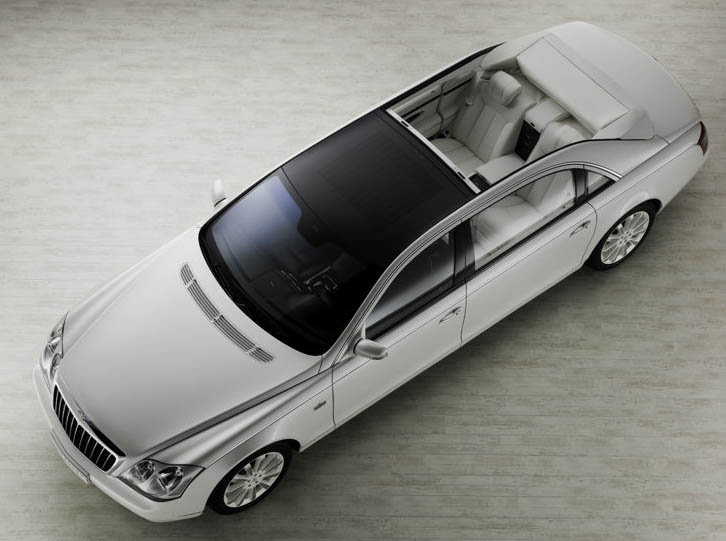
Maybach has re-enlivened the great art of building majestic automobiles. True to the tradition of exclusive landaulets, the roof of this sparkling white one-off study can be opened fully at the rear, while the chauffeur's compartment remains completely enclosed. The passengers are then able to enjoy the clear, blue sky above. Seated in opulent armchairs upholstered in white, they are treated to a majestic open-air experience currently unrivalled by any other automobile in an environment of the utmost luxury and exquisite. Romance close to the heart of nature is harmoniously combined with the ultimate in comfort and technological sophistication. With this unique study, Maybach is once again demonstrating its expertise in building the world's most exclusive luxury cars.

Large folding roof for passengers in the rear
In technical terms the Landaulet study is based on the Maybach 62 S - which can claim to be the world's most powerful series-produced chauffeured saloon. Maybach technicians have removed the rear roof module in order to afford passengers an unobstructed view of the sky above. The side walls remain, and have merely been invisibly reinforced with an integral tubular steel structure. As these measures have not altered the silhouette of the luxury saloon, the generously dimensioned doors and the complete interior with its reclining seats remain unchanged.

When closed the black soft-top of the Landaulet rests on the frame formed by the roof bows, and is wind and weather-proof. When requested by the passengers, the chauffeur operates a switch in the centre console. The roof then opens electro-hydraulically and is gently deposited on the parcel shelf in the rear, together with its integral of single-layer safety glass. Opening and closing the roof takes 16 seconds. The chauffeur is able to enclose the folded roof with a fitted cover, which both conceals the roof mechanism from view and completes the overall picture of outstanding elegance.

Generous spaciousness and first-class comfort
Outstanding comfort is assured by the generous spaciousness of the rear, which the Landaulet study has adopted unchanged from the Maybach 62. Passengers are welcomed into the interior by two large, single seats. These elegant seats also allow even very tall passengers to enjoy a reclining position which travellers normally only encounter in the first-class armchairs of modern passenger jets.

The study is designed as a chauffeured vehicle and features a partition. The upper section of the partition is a glass panel which the passengers can render opaque at the touch of a button, thanks to a liquid crystal membrane embedded in the glass.

Two ultra-modern automatic climate control systems, whose parameters have been adapted to the Landaulet study, ensure that open-air travel remains a pleasure even under adverse climatic conditions.

Engine and suspension
The Maybach Landaulet study is powered by the uprated V12 engine which Maybach engineers have developed further for the Maybach 57 S and Maybach 62 S together with the specialists at Mercedes-AMG. The V12 develops a maximum output of 450 kW/612 hp from a displacement of 5980 cubic centimetres.
The electronically controlled air suspension AIRMATIC DC (Dual Control) and the Adaptive Damping System (ADS II) endow the Landaulet with outstanding levels of ride comfort, at the same time demonstrating that even a prestigious vehicle such as this can exhibit extraordinary agility and dynamic performance.

Wednesday, September 1, 2010

Lotus Hot Wheels Concept, 2007

Lotus Hot Wheels Concept, 2007


Group Lotus plc has teamed up with Hot Wheels, the famous global die-cast brand, to design, develop and produce a Lotus Hot Wheels Concept vehicle. This 1:5 scale model was on displayed to the world at the annual SEMA Show at the Las Vegas Convention Centre in November 2007, and a 1:64 scale version of the design will become part of the Hot Wheels product range in spring 2008.

To celebrate its 40th anniversary next year, Hot Wheels approached Lotus and other world leaders in he automotive industry with the challenge for each company to produce a vehicle that embodies its own engineering philosophy and brand.

Lotus Design's international reputation for designing visually dynamic and exhilarating sports cars perfectly fitted the brief for this program and relished the opportunity to design a concept that was free from the typical technical and legal constraints of a full size car. In addition the design offered unique challenges because it has to work as a toy and therefore had to remember how specific views, features and tactile qualities of toy cars fascinated.

Related Posts Plugin for WordPress, Blogger...